
A Quiet Revolution in Quantum
For decades, quantum computing has been portrayed as an austere scientific cathedral — majestic, complex, and accessible only to a small priesthood of PhDs working deep inside elite laboratories. Progress was measured in theoretical proofs, citation counts, and incremental hardware milestones. Innovation moved slowly, guarded by institutional walls and steep academic hierarchies. The Quantum Open Source Software Survey 2025, published by the Unitary Foundation, suggests that this image is no longer accurate. In fact, it may be dangerously outdated. Beneath the surface of qubits, gates, and error rates, a sociological transformation is underway. The quantum ecosystem is becoming younger, flatter, and more open. And this shift is not cosmetic — it is structural. This is not merely a story about demographics. It is a story about power, access, and the future trajectory of one of the most consequential technologies of the 21st century.
When Quantum Stopped Belonging to a Few
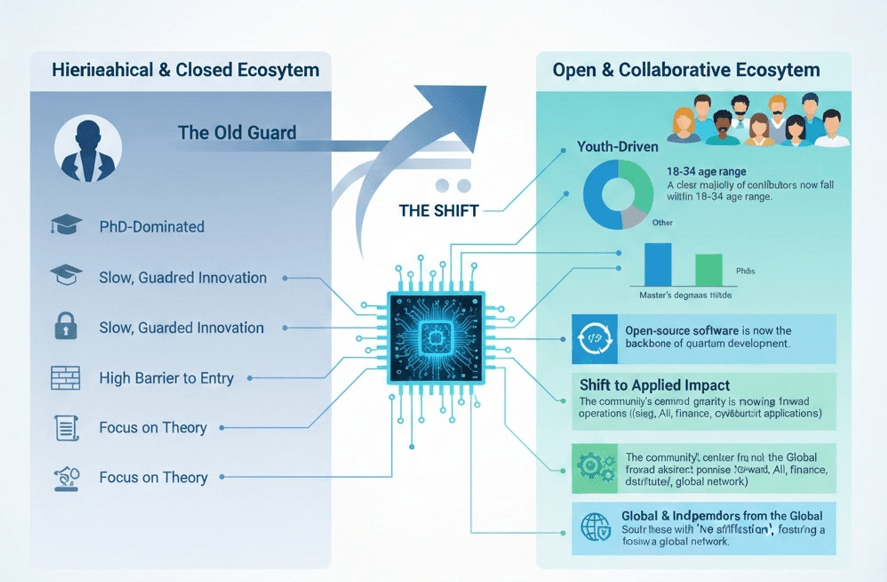
One of the most striking findings of the 2025 survey is the age distribution of contributors. A clear majority now falls within the 18–34 age range. This is not a marginal trend; it is a generational handover. Historically, quantum research required years — often decades — of advanced mathematical and physical training before meaningful contribution was possible. The new data tells a different story. Young contributors are no longer waiting at the gates of the field; they are actively shaping its core infrastructure. This matters because age is not just a number — it correlates strongly with risk tolerance, openness to experimentation, and interdisciplinary thinking. Younger contributors are more likely to:
- Combine quantum computing with AI, cybersecurity, finance, and biology
- Prioritize usable software over theoretical elegance
- Question inherited assumptions about how quantum systems should be built or programmed
The Decline of the PhD Monopoly
Perhaps even more revealing is another survey milestone: for the first time, contributors with Master’s degrees outnumber those with PhDs. This does not signal a decline in rigor. It signals a redistribution of agency. For years, the PhD functioned as an informal license to participate meaningfully in quantum research. Without it, talented engineers and applied scientists were often relegated to peripheral roles. The survey data suggests that this gatekeeping function is eroding. Why? Because modern quantum progress increasingly depends on:
- Software engineering
- Algorithm implementation
- Error mitigation techniques
- Simulation frameworks
- Tooling, documentation, and community support
These are domains where competence matters more than credentials. Open-source quantum projects reward contribution quality, not academic lineage. This shift is deeply disruptive — and deeply healthy.
Open Source as a Force Multiplier
The survey reinforces what many practitioners already feel intuitively: open-source software is now the backbone of quantum development. Frameworks, simulators, libraries, and benchmarking tools are no longer side projects — they are the field’s nervous system. Without them, collaboration across institutions and countries would collapse.
Open source changes quantum computing in three fundamental ways:
- It Lowers the Barrier to Entry
A student in Yemen, Nigeria, or rural India can now experiment with quantum algorithms using cloud simulators and open repositories — something unimaginable a decade ago. Hardware access remains limited, but conceptual access has exploded.
- It Accelerates Knowledge Transfer
Instead of waiting for journal publications, ideas propagate through code, issues, pull requests, and discussions. Learning happens in real time, across borders.
- It Rebalances Power
When core tools are open, no single corporation or institution fully controls the field’s direction. Influence flows toward those who build, maintain, and improve shared infrastructure. This is not ideological openness. It is practical efficiency.
From Theory to Consequence
Another subtle but critical implication of the survey is the shift toward applied impact. Quantum computing is still far from large-scale fault tolerance. But the community’s center of gravity is moving away from abstract promise and toward operational relevance. We see this in the rise of:
- Hybrid quantum–classical workflows
- Noise-aware algorithms
- Domain-specific quantum heuristics
- Security and cryptography applications
Young contributors and non-PhD professionals often approach quantum not as a philosophical puzzle, but as a tool — imperfect, noisy, but potentially useful now. This pragmatic mindset may ultimately do more to advance the field than another decade of speculative supremacy claims.
The Hidden Political Economy of Quantum
There is a deeper layer to these findings — one rarely discussed. Quantum computing has become geopolitically sensitive. Governments invest billions. Corporations guard roadmaps. Talent migration is monitored. In such an environment, who gets to participate matters enormously. Open-source quantum communities quietly undermine monopolization. They create parallel channels of innovation that are harder to contain, censor, or fully control. The survey data suggests that the quantum future may not be dictated solely by:
- National laboratories
- Defense-funded projects
- Closed industrial stacks
Instead, it may emerge from a distributed, global network of young contributors building tools in public. This is both an opportunity and a challenge.
Risks Beneath the Optimism
The trends highlighted by the Unitary Foundation are promising — but not without risk.
- Burnout among young contributors is real, especially in open-source environments with limited financial support.
- Fragmentation of tools can slow standardization.
- Shallow engagement risks replacing deep understanding with surface-level experimentation. A younger, more accessible field must still invest in mentorship, depth, and long-term sustainability. Democratization without structure can become chaos.
What This Means for the Next Decade
If these trends continue, the quantum ecosystem of the 2030s will look radically different from that of the 2010s. We are likely to see:
- Fewer rigid academic hierarchies
- Stronger links between quantum and other computational fields
- Increased participation from the Global South
- Open-source projects shaping de facto standards
The most influential figures may not be those with the longest CVs, but those who maintain the most trusted repositories.
A Field That Finally Feels Alive
The Quantum Open Source Software Survey 2025 does not announce a finished revolution. It documents one in progress. Quantum computing is still hard. Still fragile. Still uncertain. But it is no longer sealed off. It is being argued over in public. Built by young hands. Stress-tested by engineers. Reimagined by people who do not ask for permission. And that — more than any qubit count — may be the most important signal of all.
The future of quantum is not just more powerful. It is more human.